Overview
P2P.AI is a peer-to-peer trading platform for high-value physical commodities such as gold, silver, and similar collectible assets.
The project was built in 2025 by a small team: one Product Owner and one Product Designer.
My role covered:
Product discovery
UX strategy
Product design
System design
MVP vibe coding
Although the platform supports multiple types of metals, the first version focused mainly on silver trading, as demand for physical silver in Vietnam was growing quickly after the strong rise in gold prices.
Market Context
During market research, we noticed something interesting:
Buyers already existed.
Sellers already existed.
Liquidity already existed.
Trading communities already existed.
Users were already trading through:
Facebook Groups
Messenger
Zalo
Telegram
Gold and silver trading communities in Hanoi
The problem was not finding someone to trade with.
The problem was trading a high-value physical asset with someone you barely know.
In most transactions, users faced the same questions:
Can I trust this person?
Do they really own the asset?
Will they show up on time?
Who handles the dispute if something goes wrong?
What happens if I deposit money first?
The market already had liquidity.
What it lacked was trust infrastructure.
The Real Problem Was Trust
At the beginning, we thought the problem was about creating a new marketplace.
But after research, the strongest insight became clear:
Users were not struggling to find people to trade with.
Users were struggling to trust the people they traded with.
This changed the entire product direction.
Instead of focusing mainly on listings, feeds, or discovery, we started focusing on the trust workflow.
Trust Is a Workflow
Most marketplaces build trust through:
Verified badges
Ratings
Reviews
KYC status
These signals are useful.
But they are not enough for high-value physical trades.
We approached the problem differently:
Trust is not a badge.
Trust is a sequence of observable actions.
In P2P.AI, trust is built through multiple layers:
Layer | Purpose |
|---|---|
Identity | Understand who the counterparty is |
KYC | Verify user identity |
Credit Lock | Create financial commitment before the trade |
Evidence | Record proof of transaction activity |
Timeline | Set limits for trade execution |
Transaction History | Build a record of past behavior |
Review | Capture feedback after completed trades |
Instead of judging a user only by their profile, buyers and sellers can evaluate the full behavior around a transaction.
The Challenge
The biggest challenge was balancing three things:
Security
Trust
Transaction speed
If we added too many verification steps, users would leave the platform.
If we removed too much control, the system would not be trustworthy enough.
A key principle guided the product:
Add friction only where it reduces risk.
Every extra step had to justify itself.
If a step did not reduce transaction risk, it was removed.
Transaction Room
The marketplace was only the starting point.
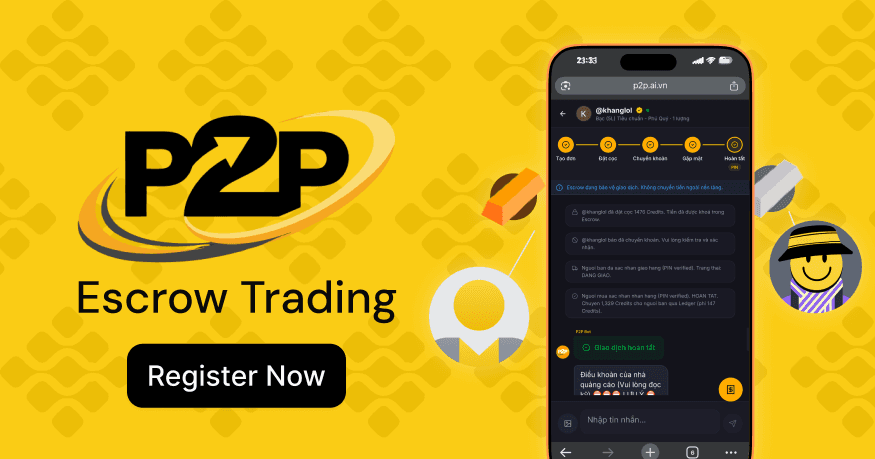
The Transaction Room became the real product.
Each trade creates a unique Transaction Room with a slug linked to the transaction owner.
The entire trade happens inside this shared space.
What the Transaction Room includes
Feature | Purpose |
|---|---|
Chat | Communication between buyer and seller |
Status | Track the current state of the trade |
Credit Lock | Manage financial commitment |
Timeline | Track transaction time limits |
Evidence | Upload proof and supporting documents |
System Log | Record platform-side activities |
Review | Collect feedback after the transaction |
Instead of scattering information across multiple chat apps, the full transaction context is kept in one place.
This makes tracking, verification, and dispute review much easier.
Designing Commitment Before Handover
One of the most important product decisions was the Credit system.
Credit was not designed as a digital wallet.
It was designed as a commitment layer for trading.
Users deposit money through VietQR.
The system issues the equivalent amount of Credit.
During a transaction:
Credit is locked into the Treasury.
After the transaction is completed:
Credit is released based on the transaction status.
The basic workflow is:
This creates a commitment mechanism before the physical asset changes hands.
Evidence & Transaction Modes
Real-world transactions do not all happen in the same way.
The platform supports three main transaction modes:
Direct Meeting
Buyer and seller meet in person to exchange the asset.
Deposit First
One party places a deposit before the transaction is fully completed.
Delivery
The asset is delivered through a shipping or logistics provider.
Each mode has its own:
Status flow
Lock level
Evidence requirements
The evidence model was inspired by common P2P flows in crypto trading platforms.
The rule is simple:
No evidence. No release.
Users are responsible for providing proof if they want the system to confirm and release the transaction.
Key Decisions
Decision | Why | Impact |
|---|---|---|
Trust-first product | Liquidity already existed | Focused the product on the real problem |
Transaction Room | Keep all transaction context in one place | Reduced scattered information |
Credit Lock | Create financial commitment | Reduced low-intent or abandoned trades |
Time-limited Room | Avoid becoming a general chat app | Kept the room focused on the transaction |
Evidence-driven release | Reduce dispute ambiguity | Increased transparency |
Multi-mode transaction | Support real trading behaviors | Made the system more flexible |
Outcome
The MVP was launched inside a test community.
Metric | Result |
|---|---|
Launch Status | Released |
Test Users | 54 |
Verified Merchants | 21 |
Team Size | 1 Product Owner + 1 Product Designer |
Although the first test group was small, the early result supported the core product hypothesis:
Users were willing to join a new platform if it made high-value trading feel more trustworthy.
What I Learned
This project changed the way I think about trust in product design.
At first, I thought trust was a feature.
A badge.
A verification state.
A review system.
After this project, I realized:
Trust is not a feature.
Trust is a workflow.
Users do not trust each other because of a blue icon.
They trust each other when the system helps them observe behavior, commitment, and transaction history.
That is why the Transaction Room, Credit Lock, and Evidence System became the most important parts of the product.
P2P.AI was not built to replace existing trading communities.
It was built to provide what those communities were missing:
A trust infrastructure for high-value physical trades.
Likes
0 views